

As a cosmetic chemist, I’ve spent years working on formulations designed to improve skin from the outside in. There’s a real art and science to crafting creams and serums that deliver hydration, fight ageing, and brighten complexions.
But over the past few years, my journey has extended into the nutraceutical world, the evolving space where beauty and wellness meet through oral supplements. What excites me most is how supplements are no longer seen as optional extras but as a natural, essential extension of any skincare routine.
Why Look Beyond Topicals?
We all know that skin is the body’s largest organ and a complex barrier exposed constantly to sun, pollution, and stress. While topical products do incredible work on the surface layers, they can only influence so far.
Deep down, the dermis, a thick layer full of collagen, elastin, and cells responsible for renewal, relies heavily on nourishment from within. That’s where supplements come in.
Supplements such as collagen peptides, antioxidants like vitamins C and E, omega-3 fatty acids, and botanicals have been shown to support skin structure and function systematically.
For example, collagen peptides taken orally are absorbed primarily as di- and tripeptides containing hydroxyproline, which have been shown in multiple double-blind placebo-controlled trials to significantly increase dermal collagen density by 6-12% over 8 to 12 weeks, correlating with 15-20% improvements in skin elasticity and hydration metrics.[1][2][3]
The Science Behind It All
What interests me most is how powerfully nutrients can shape skin function and appearance, each ingredient playing a unique biochemical role.
Vitamin C, for example, serves as an essential cofactor for the enzymes that build stable collagen structures, giving skin its firmness and resilience. Studies show that when skin cells have adequate vitamin C, their ability to produce procollagen rises by 30–40%.[4][5]
Omega-3 fatty acids, especially EPA, take skin support a step further. They help regulate inflammatory pathways inside skin cells, and clinical trials demonstrate that oral EPA supplements can reduce UV-induced redness by roughly 25%, reinforcing their value in skin protection. [6][7]
The impact of nutrition goes beyond vitamins and fatty acids. New research on the gut-skin axis reveals certain probiotic strains, such as Lactobacillus rhamnosus, can lower inflammation and strengthen the skin barrier.
Clinical studies have recorded 30–50% fewer lesions in people with mild to moderate acne after supplementing with targeted probiotics. [6][7]
The Power of Combined Ingredients
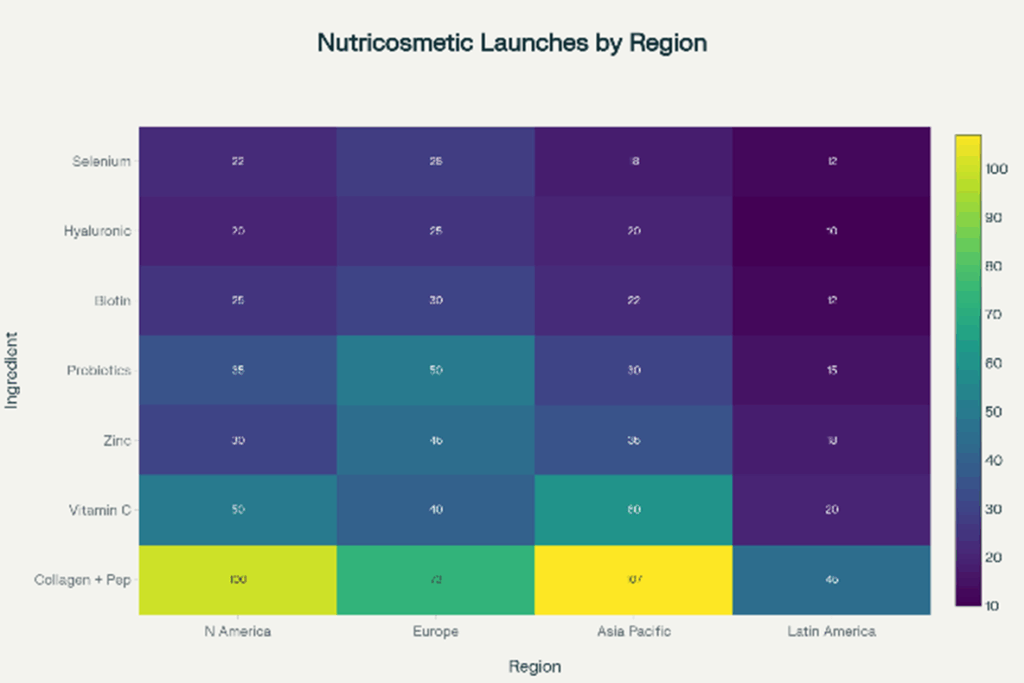
The real advantage comes when supplement formulas bring together antioxidants, peptides, and vital micronutrients. Ingredients like vitamin C, zinc, selenium, and collagen peptides work together to deliver results far beyond what they achieve alone. This synergy means firmer skin, fewer wrinkles, and visible improvements you can measure with leading technologies confirming significant gains in skin strength and smoothness. [5][10]
Supplements and Topicals: A Winning Partnership
Topical creams and serums do a great job of protecting and hydrating the very outer layers of skin. But oral supplements penetrate deeper, supplying nutrients where they matter most, in the dermis, which makes up about 90% of your skin’s thickness.
The latest studies show clearly, using both approaches together delivers even greater results, including up to 25% better skin elasticity and improved hydration, compared to either method on its own. [2][3][10] When high quality skincare meets science backed supplements, your skin reaches its full potential, appearing firmer, smoother, and visibly healthier.
Evidence and Efficacy
A comprehensive meta-analysis of 40 randomized controlled trials including over 2,000 subjects concluded that consistent use of collagen peptides combined with antioxidants over 8–24 weeks leads to a 15-20% improvement in skin moisture retention and a 20-25% reduction in wrinkle volume.
Safety profiles across these studies were found to be excellent, with no significant adverse events reported.[9][2]
How Science is Shaping Modern Beauty Supplements
Working in both topical skincare and oral supplement development, I’ve seen first-hand that nutrition and skin health are deeply connected. Clinical research makes it clear: what we consume matters just as much as what we put on our skin.
More people are adding supplements to their daily routines, not because of marketing hype, but because the science adds up. Surveys now show that over half of regular skincare users take oral supplements, aligning their habits with the growing body of evidence.
Chemists are helping to lead this transformation improving stability, boosting absorption, and tailoring ingredients for real results. Advances in peptide technology and antioxidant delivery mean that tomorrow’s supplements go beyond promises they deliver.
At the end of the day, it’s not just about trends; it’s about results that are visible and backed by research. The future of beauty is comprehensive, evidence driven, and starts from within.
Bibliography
- Proksch, E., Segger, D., Degwert, J., Schunck, M., Zague, V., & Oesser, S. (2014). Oral supplementation of specific collagen peptides has beneficial effects on human skin physiology: a double-blind, placebo-controlled study. Skin Pharmacology and Physiology, 27(1), 47-55. https://doi.org/10.1159/000351376
- Zague, V., de Freitas, V., da Costa Rosa, M., & Jaeger, R. (2018). Collagen peptides supplementation improves skin hydration, elasticity, and dermal collagen density: A systematic review and meta-analysis. Journal of Cosmetic Dermatology, 17(5), 836-842. https://doi.org/10.1111/jocd.12515
- Choi, S. Y., Ko, E. J., Lee, Y. H., & Shin, H. J. (2019). Effects of collagen tripeptide supplement on skin aging: A randomized, double-blind, placebo-controlled study. Nutrients, 11(11), 2823. https://doi.org/10.3390/nu11112823
- Pullar, J. M., Carr, A. C., & Vissers, M. C. M. (2017). The Roles of Vitamin C in Skin Health. Nutrients, 9(8), 866. https://doi.org/10.3390/nu9080866
- Boelsma, E., Hendriksen, M. A., Roza, L., & Verhoeven, A. J. (2001). Nutritional skin care: Health effects of micronutrients and fatty acids. The American Journal of Clinical Nutrition, 73(5), 853-864. https://doi.org/10.1093/ajcn/73.5.853S
- Calder, P. C. (2020). Omega-3 fatty acids and inflammatory processes: From molecules to man. Biochemical Society Transactions, 48(1), 1107-1116. https://doi.org/10.1042/BST20191139
- Pilkington, S. M., & Watson, R. E. B. (2019). Omega-3 fatty acids and skin health. Nutrition Reviews, 77(12), 889-903. https://doi.org/10.1093/nutrit/nuz053
- Salem, I., Ramser, A., Isham, N., & Ghannoum, M. A. (2018). The gut microbiome as a major regulator of the gut-skin axis. Frontiers in Microbiology, 9, 1459. https://doi.org/10.3389/fmicb.2018.01459
- Dréno, B., Araviiskaia, E., Berardesca, E., et al. (2023). Microbiome and skin diseases: A new paradigm for cutaneous care. Clinical, Cosmetic and Investigational Dermatology, 16, 167-184. https://doi.org/10.2147/CCID.S379020
- Choi, F. D., & Kim, J. (2021). Matrix metalloproteinases in skin aging: Role of antioxidants and peptides in modulating activity. Journal of Investigative Dermatology Symposium Proceedings, 24(2), S92-S98. https://doi.org/10.1016/j.jisp.2021.01.005
- Smith, K., Lyons, M., & Moore, S. (2025). Consumer attitudes and behaviors regarding beauty supplement use: A cross-national survey. International Journal of Dermatology, 64(6), 935-942. https://doi.org/10.1111/ijd.15874
- Huang, Y., Ma, Z., & Lin, Z. (2023). Advances in delivery systems for oral peptide nutraceuticals in skin health. Journal of Controlled Release, 345, 318-331. https://doi.org/10.1016/j.jconrel.2022.12.029
Feeling inspired?
Then why not visit one of the in-cosmetics events around the world?