

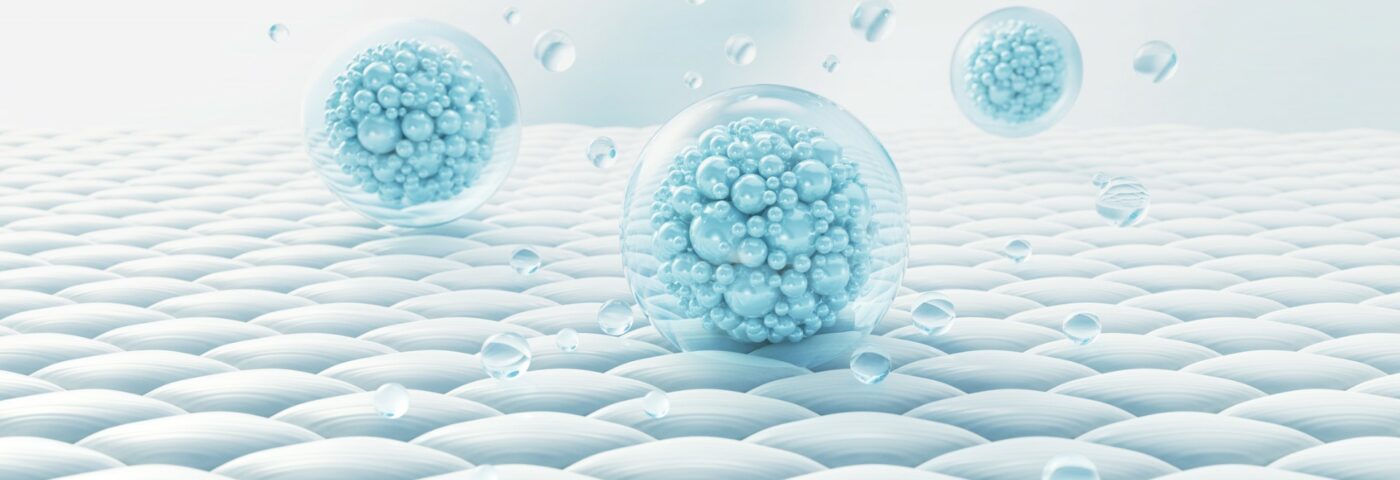
Why is everybody talking about exosomes?
We are entering a revolutionary era in skincare, one that transcends face moisturisers and serums to incorporate the realm of cellular communication and regenerative dermatology to develop innovative pro-aging skincare products. At the heart of this shift lies exosomes, nanoscale messengers poised to redefine Beauty Science.
As the Cosmetic Scientist, Faiza Hussain mentioned in her article published on in-cosmetics Connect last May 2025, “At this year’s in-cosmetics Global, several exhibitors notably unveiled exosome and exosome-like innovations, highlighting the growing momentum and diverse applications that are fascinating formulators and manufacturers.”
Indeed, exosomes are transforming the way we think about skincare products: formulations no longer simply addressing surface issues, they work on a cellular level to regenerate, repair, and rejuvenate our skin.
A Cellular skincare revolution
Exosomes represent a fundamental shift in skincare from skin hydration to active molecular signalling and regeneration. They embody the future of beauty: science-driven, biotech-enhanced, and built on solid molecular foundations.
As the cosmetic industry accelerates towards this cellular revolution, exosomes are at the leading edge, associated with the new era of molecular skincare.
The benefits of molecular skincare products have been proven by scientific research, such as:
- Boosting collagen and elastin synthesis to strengthen extracellular matrix (ECM) integrity
- Accelerating cell repair and mitigating cell damage
- Reducing skin inflammation and oxidative stress
- Enhancing skin barrier function and hydration – The skin barrier has been one of the biggest trends in skincare since last year!
- Reactivating senescent cells – Cellular senescence is included in the “12 Hallmarks of Aging”; senescent cells secrete inflammatory factors that accelerate skin aging. These 12 interconnected hallmarks define skin aging at the molecular level, and the biological changes that occur in our skin over time as we age.
Read more here: The biology of beauty: How skin longevity and biological hallmarks are shaping the next-gen of skincare products.
Exosomes offer skin regeneration beyond purely corrective effects, elevating the product development to the next level of innovation. These nano-sized extracellular vesicles (30-150 nm) are secreted by cells to mediate communication and repair. In skin care product development, they are considered intelligent messengers that deliver active ingredients as powerful “repair messages” to skin cells.
Exosome biology in skin regeneration: A molecular perspective
Exosomes, as nano-scale extracellular vesicles, play a pivotal role in skin regeneration due to their unique ability to deliver molecular signals between cells, actively reprogramming recipient cell behavior.
Here’s how exosome biology enhances skin repair at the molecular level:
- Cargo Delivery: Exosomes contain proteins, lipids, mRNAs, microRNAs, and growth factors, all crucial for modulating cellular functions. Upon release by donor cells, exosomes are internalized by skin cells via endocytosis, membrane fusion, or ligand–receptor interactions.
- Intercellular Communication: By transferring bioactive molecules, exosomes regulate immune responses, stimulate fibroblast activity, and coordinate complex molecular events necessary for effective tissue regeneration. They act as paracrine effectors, mimicking the functions of their parent stem cells.
Scientific foundations of exosomes in skincare
Clinical and preclinical studies demonstrate that exosome-based products improve skin hydration, barrier integrity, hyperpigmentation control, wound healing speed, and anti-aging benefits such as wrinkle reduction.
The research on a systematic and comprehensive review of existing studies on the applications of exosomes in cosmetics and skincare, conducted by Villarreal-Gómez, L.J., et. al. (2025), showed exosomes have the potential to attenuate signs of aging by stimulating cellular turnover and enhancing the skin’s intrinsic repair mechanisms, which gained attention in the field of skincare and anti-aging developments. Before this study, Tienda-Vázquez, M.A., et.al. (2023) publication provides information on the use of exosomes as a promising therapy against damage from UV light, infrared radiation, sun burns.
Cosmetics Claims and exosome-like technologies
As mentioned before, exosomes show promise in accelerating skin regeneration, skin barrier support, skin inflammation reduction, and collagen synthesis. However, I researched that exosome formulations face substantial hurdles extreme sensitivity to temperature, pH, and oxidation makes stability a major issue. Many marketed products may not contain viable vesicles by the time of application, and a lack of global standards for exosome verification makes purity and dose difficult to confirm.
In response, ingredient manufacturers are developing “exosome-like” technologies, synthetic vesicles, and engineered peptides that mimic delivery functions but ensure greater consistency, safety, and regulatory compliance. Peptide technology! A rising trend in cosmetics formulations.
Looking to the future: Moving forward with a scientific perspective
Exosome-based skincare stands at the intersection of biology, biotechnology, and dermatology. In summary, exosome biotech enhances skin regeneration by acting as dynamic molecular messengers: they precisely modulate gene expression, cell phenotype, and the extracellular matrix environment to promote balanced, efficient, and scar-free tissue repair.
As cosmetics research advances, modified exosomes and plant-derived mimetics could dominate due to their stability, ethical profile, and transparent documentation. Scientific trials, regulatory harmonization, and better consumer education are crucial to this paradigm shift.
References
- Hussain, F. (2025). Exosomes and “Exosome-like” skincare. in-cosmetics Connect. https://connect.in-cosmetics.com/ingredients/exosomes/
- Stern, C. (2025). Exosomes in skin care: Promise and challenges revealed in new study. Cosmetics Design. https://connect.in-cosmetics.com/ingredients/exosomes/
- Bai, G. et al. (2024). Clinical applications of exosomes in cosmetic dermatology. Skin Health and Disease. 2024 Feb 13;4(6):e348. doi: 10.1002/ski2.348
- Haykal, D. et al. (2025). Exosomes in Cosmetic Dermatology: A Review of Benefits and Challenges. J Drugs Dermatol. 2025;24(1):12-18. doi: 10.36849/JDD.8872.
- Nguyen, S. (2024). Exosomes derived from mesenchymal stem cells: A novel agent for skin aging treatment. Biomedical Research and Therapy, 11(12), 7003-7014. https://doi.org/10.15419/bmrat.v11i12.946
- Zhao, H. (2023). Bioengineered MSC-derived exosomes in skin wound repair and regeneration. Front. Cell Dev. Biol., 27 February 2023. Sec. Stem Cell Research. Volume 11 – 2023 | https://doi.org/10.3389/fcell.2023.1029671
- Villarreal-Gómez, L.J., et. al. (2025). Use of Exosomes for Cosmetics Applications. Cosmetics 2025, 12(9) https://doi.org/10.3390/cosmetics12010009
- Tienda-Vázquez, M.A., et.al. (2023). Exosomes: A Promising Strategy for Repair, Regeneration and Treatment of Skin Disorders. Cells. 2023 Jun 14;12(12):1625. https://doi.org/10.3390/cells12121625
Feeling inspired?
Then why not visit one of the in-cosmetics events around the world?